
Traeger Woodridge Review
A research-based Traeger Woodridge review: what the 860 sq in WiFIRE grill does well, where the base model stops short, and how it compares to the Elite.
 Updated November 1, 2026

The Traeger Woodridge is the entry model of Traeger’s Woodridge Series: a WiFi-connected wood pellet grill with 860 sq in of cooking space on two racks, a 24 lb hopper, a 500°F maximum, and a single keg under the barrel that catches both grease and pellet ash, per Traeger. Traeger’s product page calls it “the all-new Traeger Woodridge grill” and lists it in its main grill menu, not among its “Legacy Grills.” It suits a backyard cook who wants to set and watch a long smoke from the couch, feeds a family on most weekends, and would rather empty one container than scrape out a grease bucket and a firepot on separate schedules.
Our short verdict: the base Woodridge is a sensible pick if app control and simpler cleanup matter more to you than extra smoke settings or side storage. Skip it if you want a Super Smoke button, a shelf, or an insulated body, because Traeger reserves those for the higher Woodridge models. This is a research-based review rather than a report on our own cooks. It pulls together Traeger’s Woodridge product page, the Woodridge owner’s manual posted on it, this model’s Amazon listing, and recall searches in the U.S. Consumer Product Safety Commission database.
This review is general product information, not repair or electrical safety advice. Follow the safety instructions in your product’s manual, supervise children, and contact the manufacturer or an authorized service center if a product sparks, overheats, or has a damaged cord.
Propane and charcoal grills are for outdoor use only (NFPA), and no grill should be used inside a home, garage or camper because of the risk of carbon monoxide poisoning (CDC); for pellet and wood-fired models, follow your manual.
We earn a commission from qualifying purchases made through links on this page. Commissions never affect our rankings or PelletSmokeLab Scores.

Traeger Woodridge Pellet Grill and Smoker


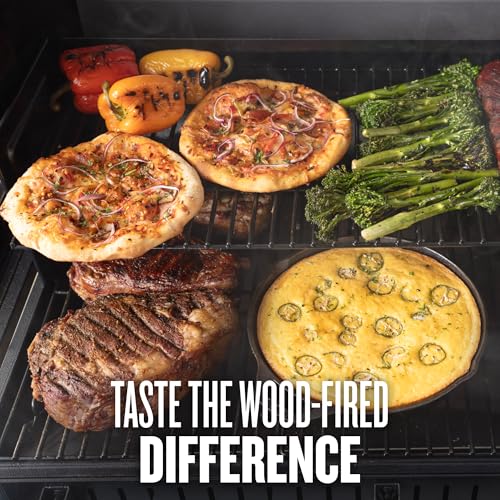
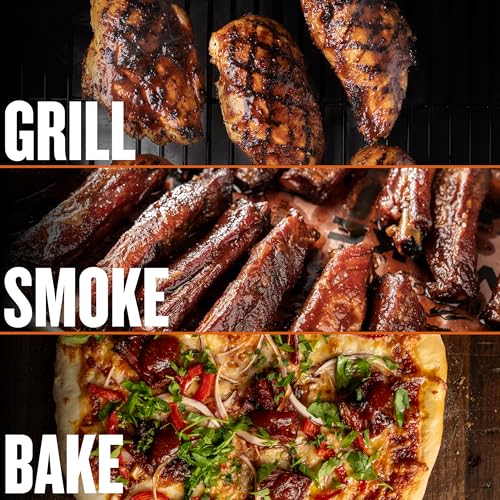
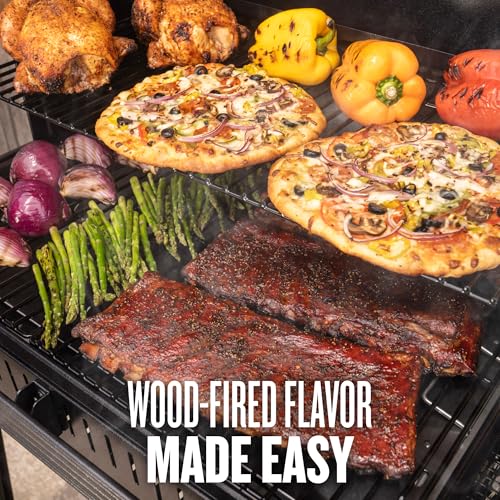
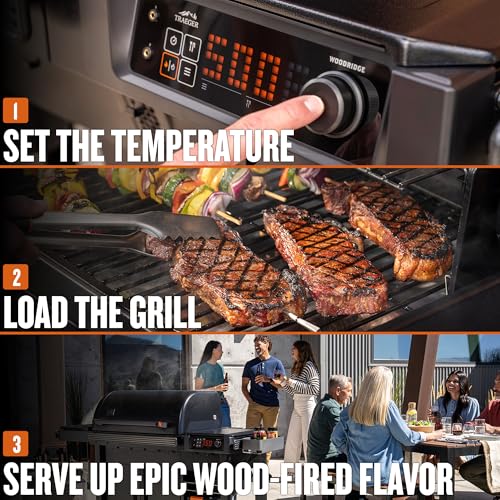

As an Amazon Associate we earn from qualifying purchases.
Traeger Woodridge at a Glance
| Spec | Traeger Woodridge |
|---|---|
| Cooking area | 860 sq in on two racks of 520 and 340 sq in (Traeger) |
| Temperature range | 500°F maximum (Traeger); the listing gives 180°F to 500°F |
| Hopper | 24 lb, with a pellet release door (Traeger, manual) |
| Connectivity | WiFIRE app control; 2.4 GHz WiFi only (manual) |
| Probes | 1 wired probe included; up to 2 wired and 2 Traeger wireless probes (manual) |
| Grease and ash | EZ-Clean Grease and Ash Keg (Traeger) |
| Food capacity | 6 chickens, 8 rib racks, or 6 pork butts (Traeger and listing) |
| Weight | 138 lb (Traeger) |
| Size | 27 x 50 x 46 in, depth x width x height (listing) |
| Warranty | 10-year limited; 1 to 3 years on many components (manual) |
| Traeger lineup status | Listed in the current Woodridge Series |
What We Like
- One container for the mess. Grease runs from the drip tray down a drain chute into the EZ-Clean Grease and Ash Keg, and the manual has you sweep firepot ash into the same keg. You slide it out from under the grill and swap the disposable liner.
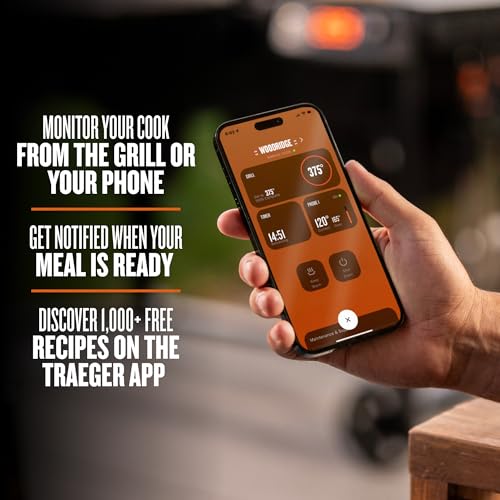
- App control without giving up the knob. The WiFIRE controller lets you set temperature and probe alarms on the grill or in the Traeger app, and Traeger’s FAQ says the grill still works without an internet connection.
- Room for four probes. The manual says the controller accepts two wired probes plus two Traeger wireless probes, so a brisket and a pork butt can each have their own alarm. One wired probe comes in the box.
- A big hopper for the size. At 24 lb, the hopper matches what Traeger lists for the Woodridge Pro and Elite, so you do not have to step up a model for fuel capacity.
- A long body warranty. Rust-through coverage on the body, legs, and hopper cover runs 10 years in the manual’s table, while the controller, auger, auger motor, and fan carry 3 years for defects.
What Could Be Better
- No Super Smoke on this model. Traeger lists Super Smoke Mode on the Woodridge Pro and Elite pages, not on the base Woodridge. Traeger’s FAQ still points to 165°F to 225°F for the most smoke flavor, so low settings are your main smoke lever here.
- Keep Warm lives in the app. The manual says Keep Warm holds the grill at 180°F and can only be turned on from the Traeger app. It adds that Keep Warm is not meant to bring food up to safe cooking standards.
- No shelf and no pellet sensor. The base grill’s parts list shows legs, wheels, and a brace, with no side or bottom shelf. Traeger lists a folding side shelf and a digital pellet sensor on the Woodridge Pro.
- Pellet and liner rules. The manual says to use only Traeger hardwood pellets, warns that other pellets may cause temperature inconsistency, and says to cover the drip tray only with Traeger liners because foil can hurt performance.
- Your WiFi has to reach the patio. The manual limits the grill to 2.4 GHz networks, and firmware updates arrive over that link.
App Control, Probes, and Temperature Swings
The Woodridge’s case rests on its controller. Setting up WiFIRE takes the Traeger app, Bluetooth turned on for a temporary pairing, and a 2.4 GHz home network; the manual says the grill cannot see 5 GHz. Once paired, you can change the set temperature, watch probe readings, and run a timer from the app. The manual recommends leaving the grill plugged in and powered on between cooks so firmware updates can download, and says it should sit in sleep mode after shutdown for the same reason. If your router is at the far end of the house, check the signal at the grill spot with your phone before you count on remote control for an overnight cook.
Expect the temperature to move. The manual says swings of plus or minus 25°F are normal on a good weather day and that the controller manages them on its own, with larger swings coming from wind, air temperature, improper use, a dirty grill, or opening the lid too often. The display counts up in 5-degree steps during preheat. Traeger’s FAQ says the Woodridge models use an RTD temperature sensor rather than a thermocouple, which Traeger credits with more accurate readings.
Probe placement follows the manual’s rule: insert up to the notch, a minimum of 2 in deep, in the thickest section and clear of bone and fatty spots, then set a goal alarm on the controller or in the app. A setting like 225°F describes the cooking chamber, not the meat. The internal target your food must hit is listed in the USDA FSIS safe minimum internal temperature chart.
Cleanup With the EZ-Clean Keg
The keg is the Woodridge’s most practical feature, and it comes with a schedule. Before each cook, the manual says to clear the drip tray (or replace its liner) and check the keg, but only when the grill and ashes are cold; it warns that failing to empty the keg could cause a serious fire. After each cook, scrape the warm grates and push grease into the keg with a nonmetallic tool. Monthly, vacuum ash from the firepot, scrape creosote from the backsplash and the back of the lid, clean the grease drain chute, and wipe the cavity with grill cleaner. The firepot ash job also comes due after roughly 20 hours of cooking.
Two smaller habits matter on this grill. The manual asks you to inspect the exhaust system each time you refill the hopper, because creosote and grease build up there. And it tells you to finish every cook with the shutdown cycle, which runs about 15 to 25 minutes depending on the last set temperature; do not flip the power switch or unplug the grill before it finishes. For a family that smokes a pork butt on Saturday and grills burgers on Sunday, that means a cold keg check before each cook and one longer clean a month.
Space, Clearance, and Power on Your Patio
Traeger splits the 860 sq in between a 520 sq in rack and a 340 sq in rack, and rates the grill for 6 chickens, 8 rib racks, or 6 pork butts. The manual suggests the lower grate for searing and roasting and the upper grate for low and slow cooks, and says the upper grate can hang on the back of the grill when you need height for a turkey. The manual pitches the space as room for party-sized orders of steaks or ribs with space left over for side dishes.
Footprint is the bigger question on a small deck. The Amazon listing gives 50 in of width, and the manual requires a minimum 20 in gap between the grill and anything that can burn, from deck railings and siding to patio furniture and trash bins. Between a railing and a wall, that adds up to roughly 90 in of open width. The manual also says not to run the grill indoors, under a combustible ceiling or overhang, or on a combustible floor, and not to store a cover or anything flammable in the space under the grill.
Plan the power run before delivery. The manual requires GFCI protection on the outlet or circuit. If you need an extension cord, it must be an outdoor type with “W-A” or “W” printed on its jacket and a No. 18 AWG cord, and the manual says not to chain cords together or route one through a window or doorway. Weather extremes count too: per the manual, ambient temperatures under -20°F or over 120°F can damage the controller’s display.
First Fire, Warranty, and Recall Check
Seasoning is required before the first cook. Per the manual, you fill the hopper at least to the safety grate, run the empty grill at 350°F for 15 minutes, then at 500°F for 45 minutes, then let the shutdown cycle finish; reaching the seasoning temperature the first time may take up to an hour. Do not wipe the protective coating off parts beforehand, and expect dark smoke and ash during this first burn. Traeger’s FAQ says assembly takes about 60 minutes.
The 10-year limited warranty is split by part in the manual: 10 years against rust-through for the body, legs, and hopper cover; 3 years for defects in the controller, auger, auger motor, fan, drip tray, ember shield, and heat baffle; 3 years against rust-through for the enameled grates; and 1 year on the hot rod, power cord, RTD and thermocouple sensors, and meat probes. Coverage starts from purchase at traeger.com or a Traeger authorized dealer, requires proof of the purchase date, and is void for grills used commercially, resold, or run with third-party parts. Amazon appears in the “National Accounts” retailer list on Traeger’s dealer page. The Amazon listing for this model shows Amazon.com as the seller; keep your invoice either way.
A brand search of the CPSC recall database returns two Traeger recalls, and neither involves the Woodridge: the Scout and Ranger portable pellet grill recall and the Flatrock flat top recall. Searches for “Woodridge” and for this model number returned nothing, and Traeger’s own recall page lists only the Flatrock.
How It Compares
Woodridge vs. Woodridge Pro and Pro Plus. Traeger’s Woodridge page describes the Woodridge Pro as 970 sq in with Super Smoke Mode and a side shelf, and its product page adds a digital pellet sensor and Keep Warm Mode. The Pro Plus has the Pro’s features plus an enclosed storage cabinet, per Traeger. The Pro keeps the 24 lb hopper and 500°F maximum. If you can live without those, the base grill does the same core job; the deciding question is whether you will use what the Woodridge Pro adds.
Woodridge vs. Woodridge Elite. The Woodridge Elite page lists the larger 970 sq in cooking area (585 and 385 sq in racks), a grill side burner for searing, sautéing, and simmering, grill body insulation for year-round cooking, Super Smoke Mode, a side shelf, a closing cabinet, a digital pellet sensor, and Keep Warm Mode. It weighs 221 lb against the base model’s 138 lb, per Traeger. Both share the 24 lb hopper, the 500°F maximum, WiFIRE, the EZ-Clean keg, and the 10-year limited warranty. Choose the Elite if you cook through cold winters or want a burner for sides next to the smoker; choose the base Woodridge if you do not.
Woodridge vs. Traeger Pro 22. If you are weighing the best Traeger grill for a first purchase, the older Pro 22 is the main alternative in the lineup: Traeger lists it with no WiFIRE, an 18 lb hopper, 572 sq in, and a 450°F top setting, under “Legacy Grills.” The Woodridge gives you app control, a bigger hopper and grate area, and 50 more degrees at the top.
Who Should Look Elsewhere
- You want a one-button smoke boost. Super Smoke is on the Woodridge Pro, Pro Plus, and Elite, not this model.
- You smoke through hard winters. Among the Woodridge models, Traeger’s descriptions mention insulation only for the Elite.
- Your WiFi does not reach the yard, or you want no app at all. The grill runs without internet, but you lose remote control, app-only Keep Warm, and automatic firmware updates.
- You need prep space at the grill. The base model has no side or bottom shelf in its parts list.
- Your deck is narrow. With 50 in of width and 20 in of clearance on each side, it needs about 90 in of open space.
- You want to buy any brand of pellets or line the tray with foil. The manual asks for Traeger pellets and Traeger liners.
Why You Should Trust Us
We do not conduct our own product trials; our picks draw on manufacturer specifications, owner’s manuals, and the Amazon listings, which also inform each product’s PelletSmokeLab Score. For this review we read Traeger’s Woodridge, Woodridge Pro, and Woodridge Elite product pages, the Woodridge owner’s manual, the Amazon listing for this model, and the CPSC recall records, and we name the source next to each spec. Commissions never affect our verdicts or scores. Our How We Review page explains the scoring method.
Final Verdict
The Traeger Woodridge is a connected pellet grill built around convenience: app control over 2.4 GHz WiFi, room for four probes, a 24 lb hopper, 860 sq in on two racks, and one keg for grease and ash. Its gaps are specific: no Super Smoke, no shelf, no pellet sensor, and Keep Warm only through the app. If those do not matter for how you cook, it covers the core of the Woodridge Series at its entry point; if they do, the Pro or Elite fills the gap.
Frequently Asked Questions
Is the Traeger Woodridge good for beginners?
It can be. You pick a temperature with the dial or app and the grill lights and preheats on its own. The learning curve is in the routine the manual sets out: seasoning before the first cook, preheating with the lid closed, checking the keg cold before each cook, and running the shutdown cycle every time.
What is the difference between the Traeger Woodridge and the Woodridge Elite?
Per Traeger, the Elite adds 110 sq in of cooking space (970 vs. 860), a grill side burner, body insulation, Super Smoke Mode, a side shelf, a closing cabinet, a pellet sensor, and Keep Warm Mode. Both share the 24 lb hopper, 500°F top temperature, WiFIRE, and EZ-Clean keg.
Can you use the Traeger Woodridge without WiFi?
Yes. Traeger’s FAQ says you can use it without an internet connection, with the controller on the grill. You give up remote control, Keep Warm (app only, per the manual), and over-the-air firmware updates.
How hot does the Traeger Woodridge get?
Traeger lists a 500°F maximum, and the Amazon listing gives a range of 180°F to 500°F. Traeger’s FAQ ties the heaviest smoke flavor to cooks between 165°F and 225°F.
Does the Traeger Woodridge have Super Smoke?
No. Traeger lists Super Smoke Mode on the Woodridge Pro, Pro Plus, and Elite, but not on the base Woodridge.
Is the Traeger Woodridge a new model?
Traeger presents it as “the all-new Traeger Woodridge grill” and lists the Woodridge Series in its main grill menu, separate from the models it files under “Legacy Grills.” Availability may change, so check the seller before you buy.
About the author

Franklin Perez is the editor-in-chief, overseeing editorial standards and coverage of pellet grills and wood pellets. Franklin's role includes reviewing articles for clarity, consistent sourcing, and practical guidance for home cooks.