
Traeger Pro 22 Review
A research-based Traeger Pro 22 review: how its dial controller, 18 lb hopper, and 572 sq in grates handle low-and-slow cooks, plus upkeep and limits.
 Updated November 1, 2026

The Traeger Pro 22 is a mid-size wood pellet grill built around a plain dial controller, an 18 lb hopper, and 572 sq in of cooking space on two porcelain-coated grates, per Traeger. Traeger sells it as the Pro Series 22, describes it as “the original Pro Series (Gen 1),” and now files it under “Legacy Grills” on its own site. It fits a first-time pellet grill owner who wants to smoke ribs, pork shoulder, or a brisket on weekends without setting up an app, and who has an open patio spot near a GFCI-protected outlet.
Our short verdict: the Pro 22 is worth a close look if you want a simple low-and-slow smoker and can live without WiFi, a Super Smoke mode, or heat above 450°F. Skip it if you want to watch a cook from your phone or if you smoke through hard winters. This review is based on research, not our own product trials. It draws on Traeger’s Pro 22 product page, the Pro Series 22 and 34 owner’s manual that Traeger links from that page, the Amazon listing for this exact model, and the recall records of the U.S. Consumer Product Safety Commission.
This review is general product information, not repair or electrical safety advice. Follow the safety instructions in your product’s manual, supervise children, and contact the manufacturer or an authorized service center if a product sparks, overheats, or has a damaged cord.
Propane and charcoal grills are for outdoor use only (NFPA), and no grill should be used inside a home, garage or camper because of the risk of carbon monoxide poisoning (CDC); for pellet and wood-fired models, follow your manual.
We earn a commission from qualifying purchases made through links on this page. Commissions never affect our rankings or PelletSmokeLab Scores.

Traeger Pro 22 Pellet Grill and Smoker


As an Amazon Associate we earn from qualifying purchases.
Traeger Pro 22 at a Glance
| Spec | Traeger Pro 22 |
|---|---|
| Temperature range | Smoke setting to 450°F (Traeger); the listing puts the low end at 180°F |
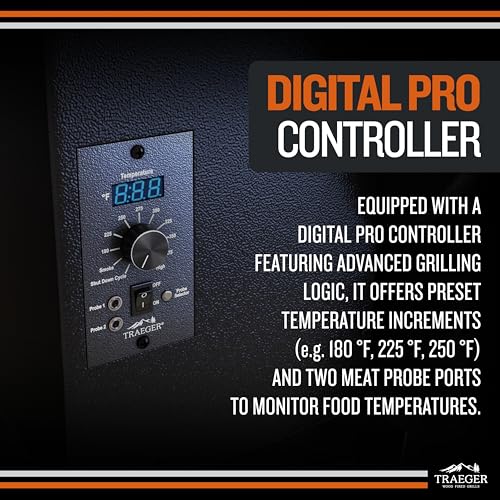
| Controller | Digital Pro Controller with a dial; the listing says it holds within plus or minus 15 degrees |
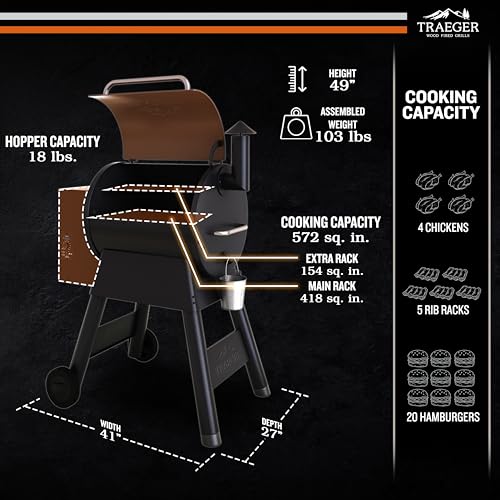
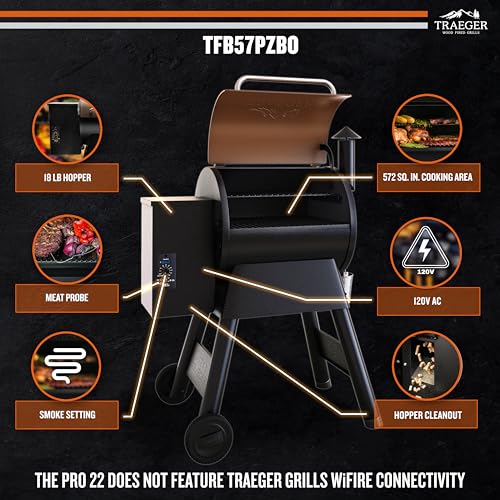
| Cooking area | 572 sq in on 2 porcelain-coated steel grates (Traeger) |
| Hopper | 18 lb, with a clean-out door (Traeger) |
| Power | 120V AC, 250 watts, 6 ft cord (Traeger); GFCI protection required (manual) |
| WiFi or app | None; Traeger says it is not equipped with WiFIRE |
| Meat probe | 1 included; the controller takes 1 or 2 probes (manual) |
| Size | 27 x 41 x 49 in, depth x width x height (listing) |
| Weight | 46.49 kg, about 102 lb (listing) |
| Warranty | 7-year limited, with shorter terms for some parts (manual) |
| Status on Traeger’s site | Listed under “Legacy Grills” |
What We Like
- Controls a beginner can learn in one evening. The manual’s controller diagram has four parts: a temperature dial, a temperature display, a main power switch, and a probe selector button. There is no app, account, or WiFi pairing to set up before the first fire.
- A real low end for smoke. Traeger’s product page says food cooked between 165°F and 225°F “will produce more smokin’ flavor” than food cooked hotter, and the Pro 22’s dial starts at a Smoke setting that the Amazon listing puts at 180°F.
- Easy pellet swaps. The 18 lb hopper has a clean-out door. Per the manual, you open it and the pellets drain into a bin; Traeger suggests a clean 5-gallon bucket also works.
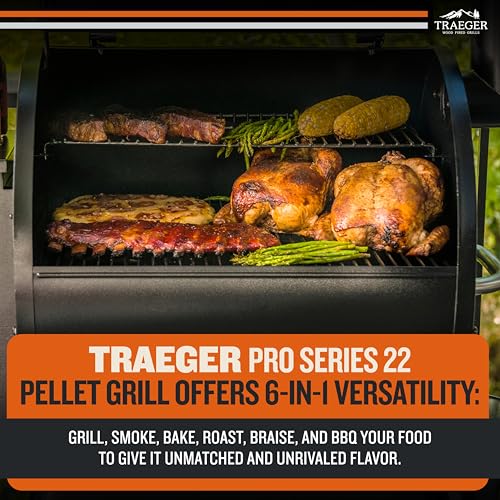
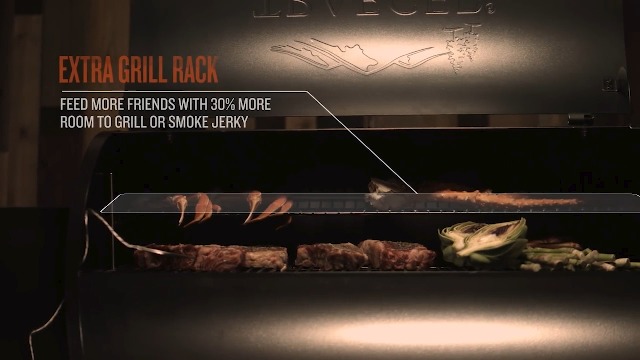
- Two-tier grate space. The 572 sq in are split over two grates, and according to the Amazon listing they fit up to 24 burgers, 5 racks of ribs, or 4 whole chickens.
- A warranty spelled out part by part. The manual’s warranty table covers the body, legs, and hopper cover against rust-through for 7 years and the fan, auger motor, and controller against defects for 3 years.
What Could Be Better
- No remote monitoring. Traeger says plainly that the Pro 22 has no WiFIRE connectivity. To check the meat you walk to the grill and press the probe button; the manual says the reading shows for 5 seconds before the display returns to grill temperature.
- A 450°F ceiling. Traeger’s own FAQ says effective searing happens between 350°F and 500°F, so the Pro 22 covers the lower part of that window and not the top.
- No insulation or extra-smoke mode. Traeger’s page lists neither. The manual suggests an insulation blanket, sold separately, for cooking in below-freezing weather.
- Upkeep is on you. The manual asks you to clean the grease system often (after every cook with fatty foods), clear the ash about every 20 hours of use, and run the full shut-down cycle after every cook.
- An older design in Traeger’s lineup. Traeger lists it under “Legacy Grills” and says it is “only available at your local retailer,” so availability may change.
How the Pro 22 Handles a Long Smoke
Starting a cook is a dial turn. The manual says to close the lid, turn the dial to your temperature, and expect the pellets to light in about two minutes with whitish-gray smoke, then let the grill preheat for 10 minutes before the food goes in. After that the lid stays shut: the manual says the grill is designed to run with the door closed, that opening it “greatly lengthens your cooking time,” and that cold or frozen food will pull the temperature down for a while. For a pork shoulder, that means resisting the urge to peek every half hour.
Temperature will move. The Amazon listing says the Digital Pro Controller holds within plus or minus 15 degrees, and the manual says fluctuations are normal for Traeger grills, with bigger swings coming from wind, air temperature, an improper start-up, or a dirty grill. On a breezy afternoon, a spot sheltered from the wind (still clear of anything that can burn) is the first thing to try before you start adjusting the dial.
Fuel is the other limit on an overnight brisket. Traeger publishes the 18 lb hopper size but no burn rate on the product page or in the manual, so the practical move is to fill the hopper before bed rather than guess. If the fire does go out, the controller has a safeguard: the manual’s low temperature alarm shuts off the grill’s components when the grill stays below 120°F for 10 minutes, and the manual names running out of pellets as one cause. A matching high temperature alarm trips at 550°F. The manual also asks for pellets that are dry, shiny, and snap cleanly, and warns never to use heating fuel pellets, which may contain contaminants.
Winter cooking is possible with care. The manual says the grill can run in light rain or light snow if the cord connection stays clear of water and snow, recommends an insulation blanket for below-freezing weather, and warns that the controller display may be damaged below -20°F.
Space, Footprint, and the Meat Probe
According to the Amazon listing, the two grates fit up to 5 racks of ribs or 4 whole chickens, which is a useful yardstick for a household’s weekend cook. If you regularly need more than that at one time, the Pro 34 is the closer fit: Traeger’s manual covers both grills and gives the Pro 34 884 sq in.
Measure your patio before you buy. The Amazon listing gives 41 in of width, 27 in of depth, and 49 in of height, and the manual requires at least 18 in of clearance from combustibles such as wooden railings, home siding, window frames, furniture, trees, and trash cans. It also says not to run the grill under a combustible ceiling or overhang. A 41 in grill between a railing and a wall therefore needs a gap of roughly 77 in. On a small deck, that clearance matters more than the cooking area.
Traeger includes one meat probe, and the manual says the controller has plug-in holes for one or two probes, with extra probes sold separately. It asks you to push the tip at least 2 in into the thickest part of the meat, away from fat and bone, and to confirm doneness with a separate meat thermometer after the food comes off the grill. Smoker settings such as 225°F are grill temperatures, not the internal temperature your food needs to reach; for that, check the USDA FSIS safe minimum internal temperature chart.
Setup, Power, and Cleanup
Traeger’s FAQ estimates 30 to 60 minutes to assemble a Pro Series grill. The first fire is a one-time routine in the manual: prime the auger (it can take 2 to 4 minutes for pellets to reach the firepot), then season the grill on HIGH for 45 minutes with the lid closed, then run the shut-down cycle. That shut-down cycle is a habit to keep. Per the manual, it runs the fan for 10 minutes to burn off leftover pellets in the firepot, and you should run it after every cook.
Power planning is simple but strict. Traeger lists 120V AC, 250 watts, and a 6 ft cord. The manual says GFCI protection must be provided on the circuit or outlet, and that any extension cord must be rated for outdoor use (the manual lists cord types marked “W-A” or “W”) and be a No. 14 AWG grounded cord. It also says not to plug extension cords into one another or run one through a window or doorway. If your only outdoor outlet sits across the yard, plan where the cord will run before the grill arrives.
Cleanup is where pellet grills reward routine. Grease runs from the drip tray into a V-shaped trough, down a drain tube, and into an external bucket, and the manual says to inspect all four before each use because buildup is the most common cause of grease fires. Ash comes out about every 20 hours of use, only when the grill and ash are cold; the manual recommends a vacuum and a metal container with a tight lid for the ash. It also asks you to scrape grease and creosote from the flue pipe with a nonmetallic tool and to cover the grill when it sits outside, because wet pellets swell and jam the auger. Traeger’s drip tray liners are optional but, per the manual, help keep the grill clean.
Warranty, Availability, and Recall Check
The manual describes a 7-year limited warranty, but the term depends on the part: 7 years for the body, legs, and hopper cover (rust-through); 3 years for the grates (rust-through) and for the fan, auger motor, controller, and wheels (defects); 1 year for the hot rod, cord, temperature sensors, heat baffle, drip tray, door gasket, and meat probe. Coverage only applies to grills bought from traeger.com or a Traeger authorized dealer, and Traeger asks for proof of the purchase date. Traeger points buyers to its dealer page, which shows Amazon among the national retailers that carry its grills. Keep your order invoice, and check who the seller is if a marketplace offer comes from a third-party shop.
On availability, Traeger’s product page still lists the Pro 22, but under a “Legacy Grills” menu alongside the Pro 34 and Ironwood 885, and it says the Pro 22 is “only available at your local retailer.” Traeger does not call it discontinued on the pages we read. Availability may change, so treat it as an established model rather than a current flagship.
We also searched the CPSC recall database for Traeger and for the Pro 22 by name. Two Traeger recalls came up, and neither covers the Pro 22. One is for the Scout and Ranger portable wood pellet grills, where CPSC says grease could leak from the drip tray; the other is for the Flatrock flat top propane grills, which are not pellet grills. A search for “Pro 22” returned no recalls.
How It Compares
Pro 22 vs. Pro 34. Traeger’s Pro 34 page lists the same Smoke-to-450°F range, the same 18 lb hopper, the same 120V AC and 250 watt rating, the same single included probe, and the same lack of WiFIRE. The difference is space: 884 sq in against 572. Both sit under “Legacy Grills.” Pick the Pro 34 only if you regularly fill the Pro 22’s grates; otherwise the smaller grill heats less space with the same controller.
Pro 22 vs. Pro 575. Traeger’s Pro 575 page describes a more connected Pro: a 165°F to 500°F range, a D2 controller, WiFIRE app control, and TurboTemp, which Traeger says shortens start-up and speeds temperature recovery after you open the lid. It keeps the 18 lb hopper and lists a total weight of 124 lb. Choose the 575 if you want app control and 50 more degrees of searing heat; choose the Pro 22 if a dial is all you want.
If you are still weighing the best Traeger grill across the whole lineup, those two comparisons cover the main trade-offs within the Pro family: space on one side, connectivity and top heat on the other. Outside Traeger, the same three questions (low-end control, hopper size, and grate area) decide which pellet smoker fits your patio.
Who Should Look Elsewhere
- You want to watch the cook from your phone. The Pro 22 has no WiFIRE. Look at a Traeger with app control, such as the Pro 575.
- You sear more than you smoke. At 450°F max, the Pro 22 sits in the lower part of the searing range Traeger gives. A grill that reaches 500°F or more is a better fit.
- You cook for big crowds. If you often need more than the listing’s 5 racks of ribs or 4 chickens at once, 572 sq in will feel tight; the Pro 34 has 884 sq in.
- Your grill spot is cramped or covered. With 18 in of clearance from combustibles and no use under a combustible overhang, per the manual, a narrow balcony or covered porch may not work.
- You have no GFCI-protected outlet nearby. The manual requires GFCI protection, and the cord is 6 ft long.
- You smoke through hard winters. The Pro 22 has no insulated body, and the manual suggests buying an insulation blanket to save pellets in below-freezing weather.
Why You Should Trust Us
We do not conduct our own product trials; our picks draw on manufacturer specifications, owner’s manuals, and the Amazon listings, which also inform each product’s PelletSmokeLab Score. For this review we read Traeger’s product pages and the Pro Series owner’s manual, the Amazon listing for this model, and the CPSC recall records, and we name the source next to each spec. Commissions never affect our verdicts or scores. Our How We Review page explains the scoring method.
Final Verdict
The Traeger Pro 22 is a sensible first pellet grill for someone who mostly smokes: a dial that starts at a low Smoke setting, an 18 lb hopper, two grates totaling 572 sq in, and a manual that spells out every maintenance step. Its limits are just as clear: no app, a 450°F ceiling, no insulation, and a place in Traeger’s “Legacy Grills” menu. If those limits do not touch how you cook, it is an easy grill to live with; if any of them do, the Pro 575 or Pro 34 solves the specific gap.
Frequently Asked Questions
Is the Traeger Pro 22 good for beginners?
Yes, for beginners who are willing to follow the manual. The controls are a dial, a power switch, and a probe button, and start-up is automatic. The learning curve is in the routine: seasoning the grill before the first cook, running the shut-down cycle every time, and cleaning grease and ash on schedule.
What is the difference between the Traeger Pro 22 and Pro 34?
Cooking area. Traeger lists 572 sq in for the Pro 22 and 884 sq in for the Pro 34. Both have an 18 lb hopper, a Smoke-to-450°F range, 120V AC power, one included probe, and no WiFIRE, and the owner’s manual Traeger links from the Pro 22 page covers both models.
Does the Traeger Pro Series 22 have WiFi?
No. Traeger’s product page says the grill is not equipped with WiFIRE connectivity, so there is no app control. You read grill and probe temperatures on the controller.
How hot does the Traeger 22 Pro get?
Traeger lists a range from a low Smoke setting up to 450°F, and the Amazon listing gives 180°F to 450°F. For the most smoke flavor, Traeger’s FAQ points to cooking between 165°F and 225°F.
Is the Traeger Pro 22 discontinued?
Traeger does not use that word on the pages we read. Its site lists the Pro 22 under “Legacy Grills” and says it is “only available at your local retailer.” Availability may change, so check the seller and Traeger’s dealer page before you buy.
Can you use the Traeger Pro 22 in winter?
Yes, with limits. The manual says light rain and light snow are fine if the cord connection stays dry and clear, recommends an insulation blanket in below-freezing weather, and warns that the display may be damaged below -20°F.
About the author

Franklin Perez is the editor-in-chief, overseeing editorial standards and coverage of pellet grills and wood pellets. Franklin's role includes reviewing articles for clarity, consistent sourcing, and practical guidance for home cooks.